There’s a particular kind of frustration that hits when a bottle of wine is in your hands, the evening is set, and the one tool you need has disappeared into some drawer you haven’t opened in months. It happens to everyone — at campsites, vacation rentals, post-move apartments, and perfectly normal kitchens where a corkscrew has simply vanished. The good news: a natural cork responds to physics, and physics doesn’t require specialized equipment. What follows are methods ranked by reliability, risk, and the tools most people already have within arm’s reach — not just a list of hacks, but an honest assessment of what actually works, what gets oversold, and what you should skip entirely.
How Do I Open a Wine Bottle Without a Corkscrew
The Screw-and-Hammer Method: Actually the Best Substitute
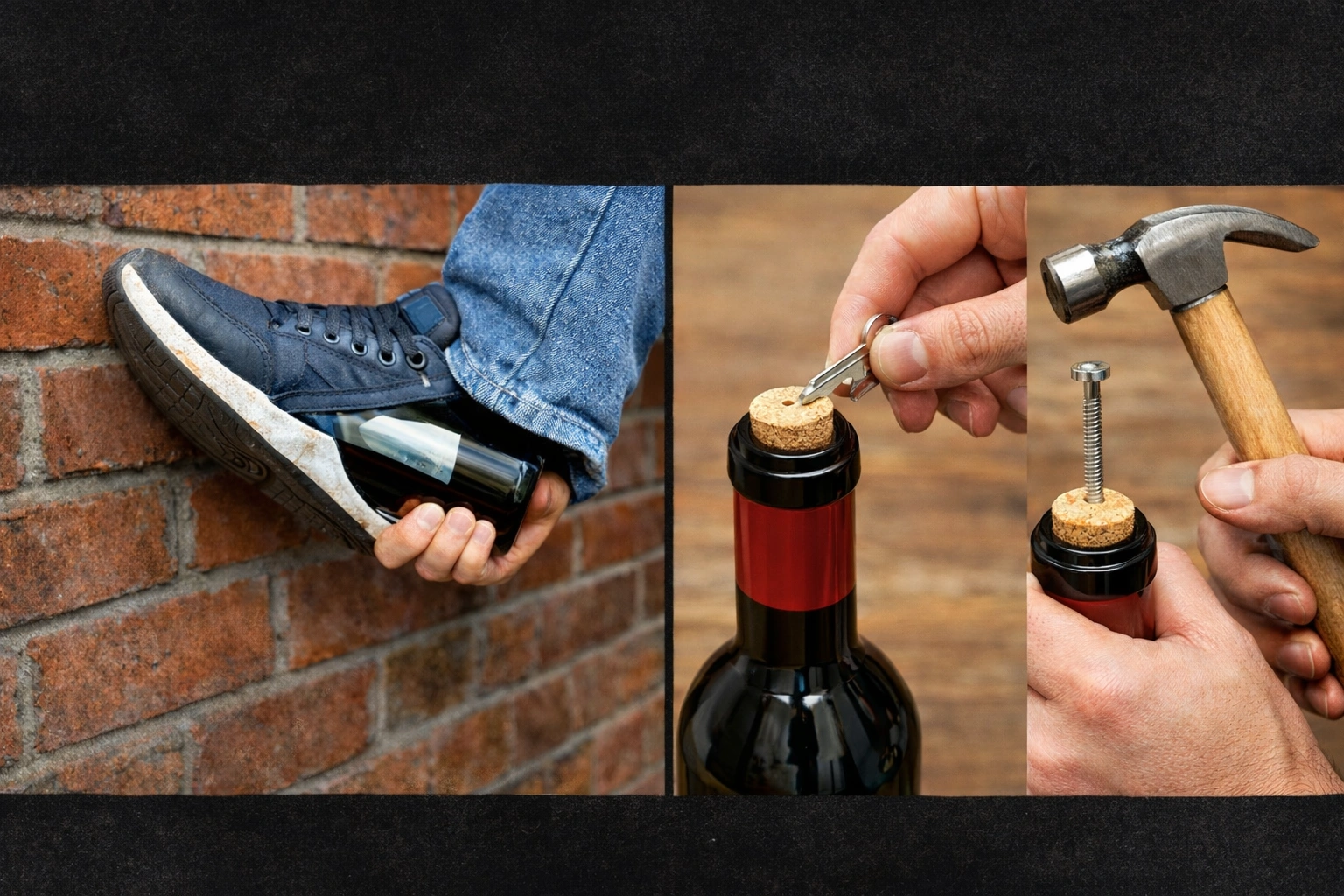
Most guides bury this one, but it deserves the top position. A long screw (2 inches or more), a screwdriver, and the claw end of a hammer replicate the mechanical action of a proper wine key more closely than anything else in your toolkit.
Drive the screw into the center of the cork using the screwdriver, leaving roughly half an inch protruding above the cork’s surface. Then hook the hammer’s claw under the exposed screw head and lever it upward, using the bottle neck’s rim as a fulcrum. The cork rises steadily, intact, with minimal drama. This method works on both natural and synthetic corks, and the controlled extraction means you’re far less likely to push fragments into the wine.
One detail most sources skip: use a wood screw, not a drywall screw. The coarser threading grips cork fiber far more securely. If the screw strips out without purchase, you’ve likely hit a crumbly cork — a sign to switch to the push-in method instead.
The Push-In Method: The Honest Compromise
Pushing the cork into the bottle rather than extracting it is widely framed as a last resort, which undersells its practicality. If you’re opening a bottle that will be consumed that evening, a cork floating inside the wine causes no harm to flavor — cork is chemically inert and doesn’t leach tannins or alter aromatics in the short term.
Use the blunt handle end of a wooden spoon, a thick marker, or any cylindrical object with enough rigidity. Press the cork straight down with firm, even pressure. It should drop cleanly on the first attempt with synthetic corks; natural corks on older bottles may require a few firm pushes and can shed small fragments — run the wine through a fine mesh strainer or cheesecloth before serving.
The critical caution here is vintage wines. Aged natural corks that have been sitting under pressure for years are prone to disintegration when pushed rather than pulled. For any bottle older than ten years, the screw-and-hammer method or the string-and-knot technique are safer for cork integrity.
The Key or Knife at 45 Degrees: Effective With Patience
A house key, car key, serrated knife blade, or even sturdy scissors — the mechanics are identical regardless of tool. Insert the object into the cork at roughly a 45-degree angle, deep enough that at least half of the cork’s height is engaged. Then rotate the cork in a slow circular motion, applying light upward pressure as you turn.
The physics at work: rotational torque combined with upward force separates cork from glass neck without the linear pulling that a corkscrew provides. It typically takes two to three full rotations before the cork loosens enough to grip and remove by hand. Rushing this is where most people go wrong — excess lateral pressure splits the cork rather than moving it.
Using a serrated knife calls for extra attention to hand placement. Wrap a kitchen towel around the bottle neck before inserting the blade, both for grip and for protection if the knife slips. Never use this method with a straight-edged blade — it won’t catch cork fiber effectively and creates unnecessary risk.
The Shoe Method: Physically Sound, Widely Misunderstood
The shoe technique works — but not for the reason most explanations give. Repeated impact against a firm surface generates hydraulic pressure within the liquid itself, which transmits force upward through the bottle neck. Liquid, being incompressible, acts as a pressure column that slowly drives the cork outward with each impact cycle.
Flat-soled footwear performs better than cushioned athletic shoes. A leather dress shoe or a wooden clog creates more direct force transfer than a thick-soled sneaker, which absorbs much of the energy you’re generating. Wrap the bottle base in a folded towel first — this protects the glass from direct contact with hard surfaces.
Hold the bottle horizontally, place the base into the shoe heel, and strike the shoe sole against a wall in firm, rhythmic strokes. Watch the cork closely — it should migrate outward gradually, a few millimeters per cycle. Stop when enough cork protrudes to grip manually and pull the rest. Going too far risks an abrupt ejection that sends wine across whatever is nearby.
This method is not appropriate for sparkling wines under any circumstances. The carbonation already exerts internal pressure; additional mechanical pressure on a sealed sparkling bottle creates unpredictable gas release.
The Bike Pump Method: Overlooked and Surprisingly Reliable
Anyone who keeps a bicycle in their home has a capable cork removal tool available. A standard pump needle, the type used for sports balls, inserts directly through the center of the cork with minimal resistance. Once the needle penetrates completely through to the air gap between cork and wine, begin pumping slowly.
Air pressure builds in that gap with each pump stroke and pushes the cork upward from below. The exit is controlled and gradual — far more so than impact methods — and the cork typically emerges intact. Pull it free once it protrudes enough to grip.
The one variable to monitor: pump too aggressively and the cork can exit without warning. Three to five slow pump strokes between pauses is a reasonable rhythm. This technique is especially effective for older natural corks that might crumble under rotational stress from a key or knife.
Heat Application: Understanding the Science Before Attempting It
Applying heat to the bottle neck causes the air trapped between the base of the cork and the wine surface to expand, generating pressure that pushes the cork outward. In controlled conditions, this works. In practice, it’s the most inconsistent method on this list and carries the most risk if done improperly.
A lighter or candle flame held to the neck — not the body — of the bottle for 20 to 30 seconds at a time can gradually build enough pressure to dislodge a cork. Rotate the bottle to distribute heat evenly. Remove any foil capsule first; wax seals must also be cleared entirely.
Never apply this to a cold bottle directly from a refrigerator. Rapid thermal gradient across chilled glass risks cracking, and the pressure differential between wine temperature and neck temperature can be unpredictable. The heat source should target only the neck above the fill line, keeping the wine itself unaffected — warming even a few centimeters of wine can noticeably alter delicate white and sparkling varietals.
This method has a genuine use case: bottles with unusually stubborn corks where other methods have partially failed and the cork has already been disturbed. Using heat as a finishing technique after partial extraction by another method is far more reliable than using it as a first approach.
The String-and-Knot Method: A Rescue Technique for Sunken Corks
This one is specifically useful when the cork has been pushed into the bottle accidentally — either by a failed attempt or an old corkscrew that lost its grip mid-pull. It’s a retrieval method, not an extraction method, and that distinction matters.
Tie a secure figure-eight knot near the end of a length of twine, shoelace, or paracord. Using a thin rigid object — a skewer, a chopstick, the edge of a butter knife — guide the knotted end past the cork and into the bottle, maneuvering it so the knot sits below the floating cork. Tilt the bottle to position the cork against the neck, then pull the string firmly upward. The knot catches the cork’s base and draws it out.
Patience matters here. The string needs to be positioned precisely, and rushing the knot placement wastes time rather than saving it. A piece of string at least 18 inches long gives you enough working length to maintain control while pulling.
What Cork Type Changes Everything
Most guides treat all corks as equivalent, which is a practical oversight. Natural bark corks, synthetic polymer corks, and agglomerated corks (compressed cork granules bound with adhesive) respond differently to each method above.
Synthetic corks are the most forgiving — they resist crumbling, accept rotational force well, and push cleanly into the bottle. The screw-and-hammer, key, and push-in methods all perform reliably on synthetics.
Agglomerated corks are the most problematic without a proper corkscrew. The granular structure means rotational extraction risks shearing layers apart, and the push-in method leaves cork fragments distributed throughout the wine rather than a single intact piece. For these, the bike pump or heat method tends to produce cleaner results.
Aged natural corks that have dried and contracted are best handled with the screw-and-hammer method. If there’s visible crumbling at the cork’s surface when you remove the foil, treat extraction as a fragile operation regardless of method — have a strainer ready before you begin.
Salvaging Wine After a Broken Cork
A cork that crumbles during extraction is frustrating but not the end of the bottle. Pour the wine through a double layer of cheesecloth or a coffee filter into a decanter, carafe, or even a clean jar. Fine mesh strainers work well for larger fragments; cheesecloth catches the smaller particles that slip through.
The wine itself is unaffected by cork contact in the short term. Cork taint — the musty compound 2,4,6-trichloroanisole — is a pre-existing chemical condition in the cork material, not something that develops from physical contact with wine during emergency opening.
If the cork fell completely inside the bottle during a push-in attempt, use a straw or chopstick as a deflector while pouring, keeping the cork away from the bottle opening. For a cleaner pour, the string-and-knot retrieval above can recover the cork from inside the bottle before serving.
The One Method Worth Skipping Entirely
Sabrage — striking the bottle neck with a knife or blunt object to shear the glass — is sometimes listed among improvised opening techniques. It belongs in its own category: a ceremonial technique for sparkling wine with a flat-bladed blade, requiring a specific bottle geometry, internal carbonation, and a practiced striking motion that takes considerable rehearsal to execute without shattering the bottle unpredictably.
Attempting sabrage with a standard still wine bottle, kitchen knife, or without prior training is likely to shatter the glass in an uncontrolled manner. The technique is not a substitute for corkscrew removal, and its inclusion in lists of everyday wine hacks does it a disservice. If you want to learn sabrage properly, find someone who has done it correctly first.
Keeping Cork Fragments Out of Fine Wine
If the bottle you’re working with has particular value — a special vintage, a gift, a cellar hold — be honest with yourself about risk before attempting any improvised method. Push-in methods alter the bottle’s resealing capacity entirely. Impact methods risk glass integrity if the cork is stuck due to adhesion. Heat methods applied to aged bottles with potentially compromised glass structure are genuinely hazardous.
For genuinely valuable bottles, the right call is the screw-and-hammer method with a long wood screw and controlled, patient levering — or simply waiting until a proper corkscrew is available. The few minutes of inconvenience are worth protecting wine that took years to develop.




 News2 years ago
 Lifestyle3 years ago
 Lifestyle4 years ago
 Wealth2 years ago