
Stories
What Are the Two Starting Materials for a Robinson Annulation?

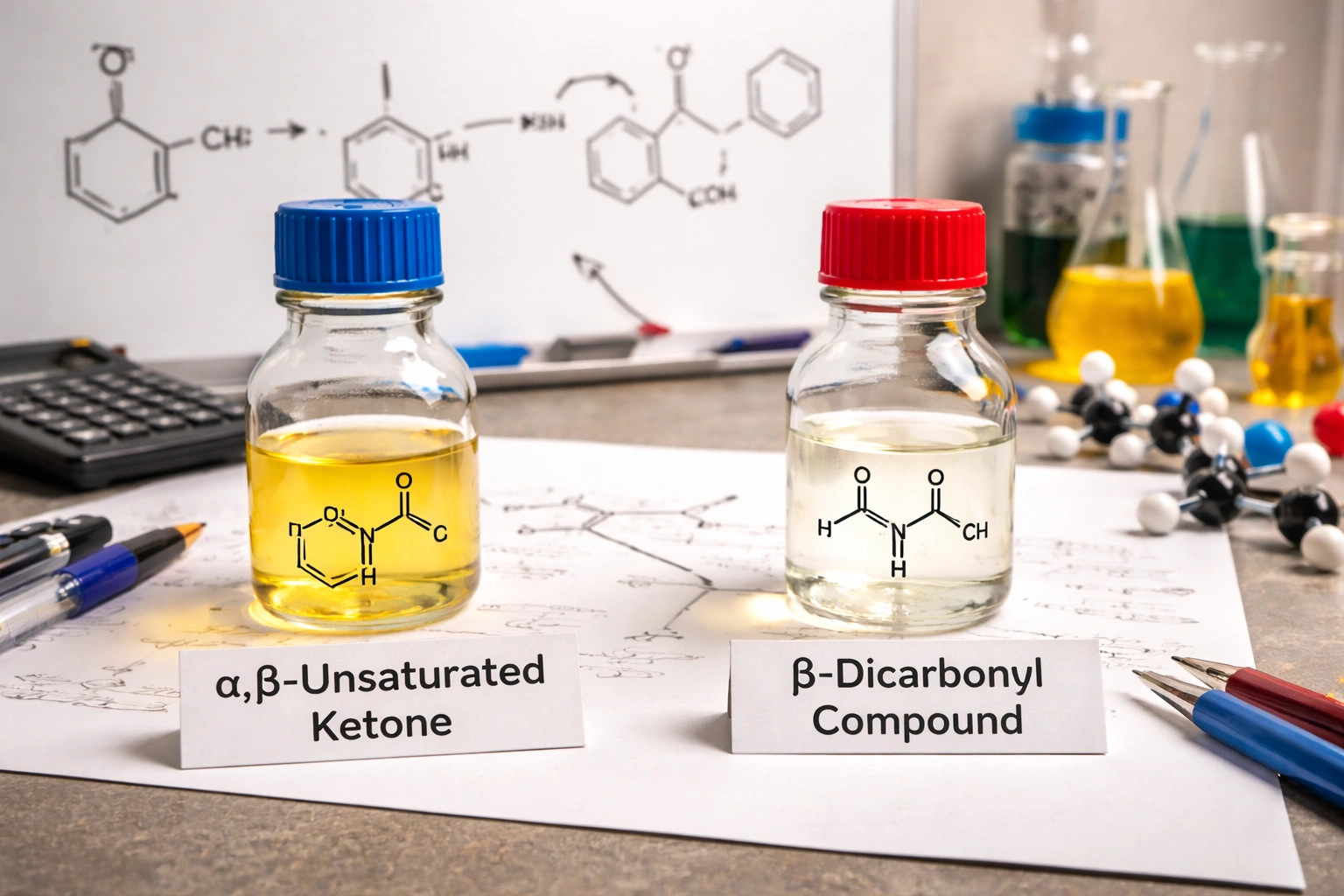
Few reactions in organic chemistry carry the elegance of the Robinson annulation. It builds a six-membered ring from two relatively simple carbonyl compounds, forging three new carbon–carbon bonds in a single synthetic sequence. But before any of that complexity unfolds, there’s a foundational question that every student and practitioner confronts: what are the two starting materials for a Robinson annulation?
The direct answer: a carbonyl compound capable of forming an enolate (the Michael donor) and an α,β-unsaturated carbonyl compound (the Michael acceptor). Those are the two chemical roles that must be filled. The specific molecules that fill those roles can vary, but the functional logic behind each starting material is fixed by the reaction mechanism itself.
Table of Contents
What Are the Two Starting Materials for a Robinson Annulation
Starting Material One: The Enolizable Carbonyl Compound (Michael Donor)
The first starting material is any carbonyl compound with acidic α-hydrogens that can be abstracted by base to generate a stable enolate nucleophile. This enolate acts as the Michael donor — the nucleophilic component in the conjugate addition step that initiates the entire sequence.
In practice, the most effective Michael donors are doubly activated carbonyl compounds: β-ketoesters, β-diketones, and cyclic 1,3-diketones. The reason is thermodynamic — a methylene group flanked by two electron-withdrawing carbonyls has a pKa in the range of 10–13, meaning deprotonation by mild base (NaOEt, K₂CO₃, NaOH) generates the enolate efficiently and cleanly without competing side reactions.
The textbook prototype is cyclohexanone or 2-methyl-1,3-cyclohexanedione, but any of the following fulfill this donor role:
- Simple ketones (acetone, cyclohexanone, methyl ethyl ketone)
- β-Diketones (acetylacetone, dimedone, 1,3-cyclohexanedione)
- β-Ketoesters (ethyl acetoacetate)
- Cyclic 1,3-diketones, which are particularly favored because the enolate forms regioselectively at the most acidic carbon
What makes the cyclic diketones especially reliable in Robinson annulation is regioselectivity control. In unsymmetrical systems, the reaction can generate multiple enolates, producing a mixture of products. Cyclic 1,3-diketones concentrate enolate formation at the activated methylene, directing the Michael addition to a single, predictable site.
What the donor is NOT: a simple aldehyde with low steric tolerance, or a ketone with no α-hydrogens. If there’s no abstractable proton adjacent to the carbonyl, no enolate forms, and the reaction cannot proceed through a Michael pathway.
Starting Material Two: The α,β-Unsaturated Carbonyl Compound (Michael Acceptor)
The second starting material is an α,β-unsaturated carbonyl compound — a molecule containing both a carbon–carbon double bond conjugated with a carbonyl group. This is the electrophilic component, the Michael acceptor, and it defines the carbon framework that gets incorporated into the new ring.
The canonical example is methyl vinyl ketone (MVK, but-3-en-2-one). It is the most widely used Michael acceptor in Robinson annulation, both in teaching and in total synthesis, because its structure provides exactly the carbon geometry needed to produce a 1,5-dicarbonyl intermediate after conjugate addition — and it’s that 1,5-relationship between the two carbonyls that makes the subsequent intramolecular aldol condensation geometrically possible for six-membered ring closure.
Other viable Michael acceptors include:
- Ethyl vinyl ketone (pent-1-en-3-one)
- Acrylonitrile and acrylate esters (though less common in classical Robinson conditions)
- Vinyl sulfones and vinyl phosphonates in modern variants
- Chalcones (1,3-diphenylpropenone) for extended aromatic systems
- 1,3-Dichloro-cis-2-butene in the Wichterle reaction variant — a modification that avoids the polymerization that MVK undergoes under strongly basic conditions
The structural requirement for the acceptor is non-negotiable: conjugation between the alkene and the carbonyl is what makes the β-carbon electrophilic through resonance. Without conjugation, the compound has no activated site for nucleophilic 1,4-addition, and the Michael reaction fails.
A subtle point most sources omit: the Michael acceptor’s chain length determines ring size. MVK contributes a three-carbon unit (C-C-C=O) to the product. When an enolate donates two carbons during conjugate addition, the resulting 1,5-dicarbonyl has the correct spacing for a six-membered ring in the aldol step. Changing the acceptor’s chain length by one carbon shifts the product ring size — an important consideration in retrosynthetic planning where five-membered rings are the target.
Why the 1,5-Dicarbonyl Intermediate Is the Pivotal Product
Understanding the two starting materials requires understanding what they produce together. The Michael addition between donor and acceptor generates a 1,5-dicarbonyl compound — two carbonyl groups separated by exactly five carbons in the chain. This intermediate is not isolated under typical Robinson conditions; it proceeds directly into the second reaction stage.
The geometry of the 1,5-dicarbonyl is what enables the intramolecular aldol condensation. The carbon alpha to one carbonyl is positioned at the correct distance to attack the other carbonyl in a six-membered transition state — the most geometrically favorable ring size in organic chemistry. Shorter spacing (1,4-dicarbonyl) would force a strained five-membered transition state; longer spacing (1,6-dicarbonyl) would require seven-membered ring formation, which is entropically disfavored.
This is why MVK is not an arbitrary historical choice — its three-carbon chain is geometrically necessary for six-membered ring formation via this mechanism.
The Specific Pair Robinson Used in 1935
When Robert Robinson and William Rapson first reported this reaction, the starting materials were cyclohexanone and an α,β-unsaturated ketone — specifically, they demonstrated that the interaction between cyclohexanone derivatives and vinyl ketones afforded cyclohexenone products. The reaction was a deliberate design, not an accidental discovery, emerging from Robinson’s deep understanding of biosynthetic pathways in alkaloid and steroid chemistry.
The reason Robinson’s work was Nobel Prize-worthy (1947) wasn’t just the reaction itself — it was the insight that nature used similar cascades to construct complex polycyclic frameworks. The annulation provided a synthetic shortcut to structural motifs that previously required many separate steps and protecting group manipulations.
How Starting Material Choice Controls the Product’s Stereochemistry
This angle rarely appears in introductory treatments but matters in advanced synthesis. The two starting materials don’t just determine connectivity — they influence the stereochemical outcome at newly formed stereocenters.
Under kinetically controlled conditions, the aldol cyclization step proceeds through a chair-like transition state. The trans product (1,2-trans relationship between substituents at the newly formed ring junction) is generally favored due to antiperiplanar alignment of the reacting groups. Solvent choice interacts with this preference: polar aprotic solvents like DMSO can shift the ratio by altering transition state solvation and ion pairing behavior.
For enantioselective synthesis, the two starting materials remain the same, but a chiral catalyst — most famously L-proline — directs the enamine intermediate formed from the donor to attack the acceptor from one face preferentially. This organocatalytic version, developed by Barbas and others, has become important for asymmetric construction of cyclohexenone cores in natural product synthesis.
Retrosynthetic Logic: Working Backward From Product to Starting Materials
If you encounter a cyclohexenone ring in a target molecule and need to identify Robinson annulation starting materials, the retrosynthetic cleavage follows a defined pattern:
- Identify the α,β-unsaturated ketone (the C=C conjugated with C=O) in the six-membered ring
- Cleave the C=C bond — this breaks the bond formed in the dehydration step
- Cleave the C–C bond between the β-carbon and the adjacent carbon on the ring — this breaks the bond formed in the aldol step
What remains after these two retrosynthetic cuts are the two original starting materials: the enolate donor fragment and the Michael acceptor fragment.
This approach is useful for exam problems and practical synthesis planning alike. The key recognition element is the cyclohex-2-enone motif (a six-membered ring with an enone). Its presence in a target molecule is a strong signal that Robinson annulation is a viable disconnection, provided no other structural features in the ring make that bond cleavage pattern impossible.
Substrate Limitations That Affect Starting Material Selection
Not every combination of donor and acceptor produces a clean Robinson annulation. Several structural features in the starting materials create problems:
Steric congestion at the β-carbon of the acceptor: A heavily substituted Michael acceptor slows conjugate addition because the nucleophilic attack must approach a hindered carbon. Fully substituted β-carbons effectively shut down the Michael step.
Competing self-condensation of the acceptor: Methyl vinyl ketone is prone to dimerization under basic conditions before the Michael donor can react with it. This is why MVK is often added dropwise or in slightly dilute conditions, and why the Wichterle modification (replacing MVK with 1,3-dichloro-cis-2-butene) was developed — the chlorinated analog doesn’t undergo competing polymerization.
Enamine alternatives for difficult donors: Simple monoketones that form enolates only under strongly basic conditions can instead be converted to enamines using a secondary amine catalyst (piperidine, pyrrolidine). The enamine acts as a nucleophilic donor equivalent without requiring harsh base. This Stork enamine approach reduces self-condensation byproducts and is particularly valuable when the donor ketone has multiple enolizable positions.
Regioselectivity in unsymmetrical donors: When the Michael donor is an unsymmetrical ketone with two distinct sets of α-hydrogens, the base may deprotonate at either position, generating two different enolates and ultimately two regioisomeric products. Using β-diketones or β-ketoesters as the donor eliminates this ambiguity, since the most acidic proton position is unambiguous.
Real Applications: Where These Starting Materials Appear in Total Synthesis
The power of the Robinson annulation in complex molecule synthesis comes from the accessibility of its two starting materials and the structural complexity generated from them in a single operation.
Cortisone synthesis: Robinson’s own students applied annulation chemistry to build the steroid D-ring, using cyclohexanone derivatives and vinyl ketones to establish the trans-decalin framework. The starting material pair in those sequences was adapted from the prototypical cyclohexanone/MVK combination with additional substitution to control stereochemistry at the ring junction.
Terpene synthesis: The Hajos–Parrish–Eder–Sauer–Weechert reaction — a proline-catalyzed intramolecular Robinson annulation — begins with a triketone derived from acetone and MVK. Here the two starting materials generate a linear precursor that cyclizes intramolecularly, building the bicyclic Wieland–Miescher ketone, a critical synthetic intermediate for terpenoid and steroid total synthesis.
Alkaloid frameworks: The annulation’s ability to build cyclohexenone rings fused to existing ring systems makes it indispensable in alkaloid synthesis, where the six-membered carbocyclic ring appears with high frequency. In each case, the donor and acceptor are chosen to install the correct substitution pattern on the newly formed ring before it is further elaborated.
Conclusion
The two starting materials for a Robinson annulation are, at their core, functionally defined: an enolizable carbonyl compound that generates a nucleophilic enolate (the Michael donor) and an α,β-unsaturated carbonyl compound that accepts that nucleophile at its β-carbon (the Michael acceptor). In the most common textbook and laboratory version, these roles are filled by a ketone or β-diketone on the donor side and methyl vinyl ketone on the acceptor side — a pairing that produces a 1,5-dicarbonyl intermediate with exactly the right geometry to close into a six-membered ring during the subsequent intramolecular aldol condensation.
The deeper significance of these two starting materials isn’t just their chemical identity — it’s what their structural relationship encodes about the product. The donor contributes the enolate carbon that forms one new bond; the acceptor contributes the β-carbon that accepts it and the carbonyl that the intramolecular aldol attacks next. Every atom in the newly formed ring can be traced back to the carbons and functional groups in those two precursors. Choosing them correctly, understanding their limitations, and recognizing their fingerprint in retrosynthetic analysis is what separates mechanical application of the reaction from genuine synthetic competence with it.

Dwayne Carter III: Age, Family, Music and Life as Lil Wayne’s Son

Dakota Brinkman: Melissa Gilbert’s Son and His Own Acting Career

Kian William Jarrahy: What’s Known About Geena Davis’s Son

James Westley Welch: What’s Actually Known About Raquel Welch’s First Husband

Irving H. Vincent: What We Actually Know About Vin Diesel’s Father

Nemin.io Review: What It Actually Offers

Domikyo.com Review: What It Is and Is It Worth Your Time?

Building a Garage in Edmonton: What It Costs and How to Plan It Right

What Are Some Examples of Failed Activewear Combinations?

Tanning Products Amazon: The Ultimate Guide to Achieving a Flawless Glow
Nemin.io Review: What It Actually Offers
James Westley Welch: What’s Actually Known About Raquel Welch’s First Husband
Domikyo.com Review: What It Is and Is It Worth Your Time?
Irving H. Vincent: What We Actually Know About Vin Diesel’s Father
Dakota Brinkman: Melissa Gilbert’s Son and His Own Acting Career
Kian William Jarrahy: What’s Known About Geena Davis’s Son
Dwayne Carter III: Age, Family, Music and Life as Lil Wayne’s Son
Dwayne Carter III: Age, Family, Music and Life as Lil Wayne’s Son
Dakota Brinkman: Melissa Gilbert’s Son and His Own Acting Career
Kian William Jarrahy: What’s Known About Geena Davis’s Son
James Westley Welch: What’s Actually Known About Raquel Welch’s First Husband
Irving H. Vincent: What We Actually Know About Vin Diesel’s Father
Nemin.io Review: What It Actually Offers
Domikyo.com Review: What It Is and Is It Worth Your Time?
Building a Garage in Edmonton: What It Costs and How to Plan It Right
What Are Some Examples of Failed Activewear Combinations?


