There’s a moment in any serious kitchen when a truffle arrives wrapped in paper, sealed in a glass jar, and smelling faintly through both. Every cook nearby stops. Not because it’s instructed — because the scent simply demands attention. That’s the nature of this ingredient. It doesn’t compete. It occupies.
Most people encounter the word “truffle” twice: once on a chocolate box, once on a restaurant menu with a price that gives them pause. These are not the same thing, and the confusion has become so routine that it’s worth addressing upfront. The truffle we’re discussing here is a subterranean fungus — one of the rarest, most biologically peculiar, and genuinely irreplaceable ingredients in the culinary world. Understanding it requires stepping outside the usual food conversation and into mycology, forest ecology, and a supply chain that depends almost entirely on rainfall, trained dogs, and luck.
What Is a Truffle — The Underground Delicacy That Commands More Than Gold
Beyond the Fungus: What Actually Makes a Truffle
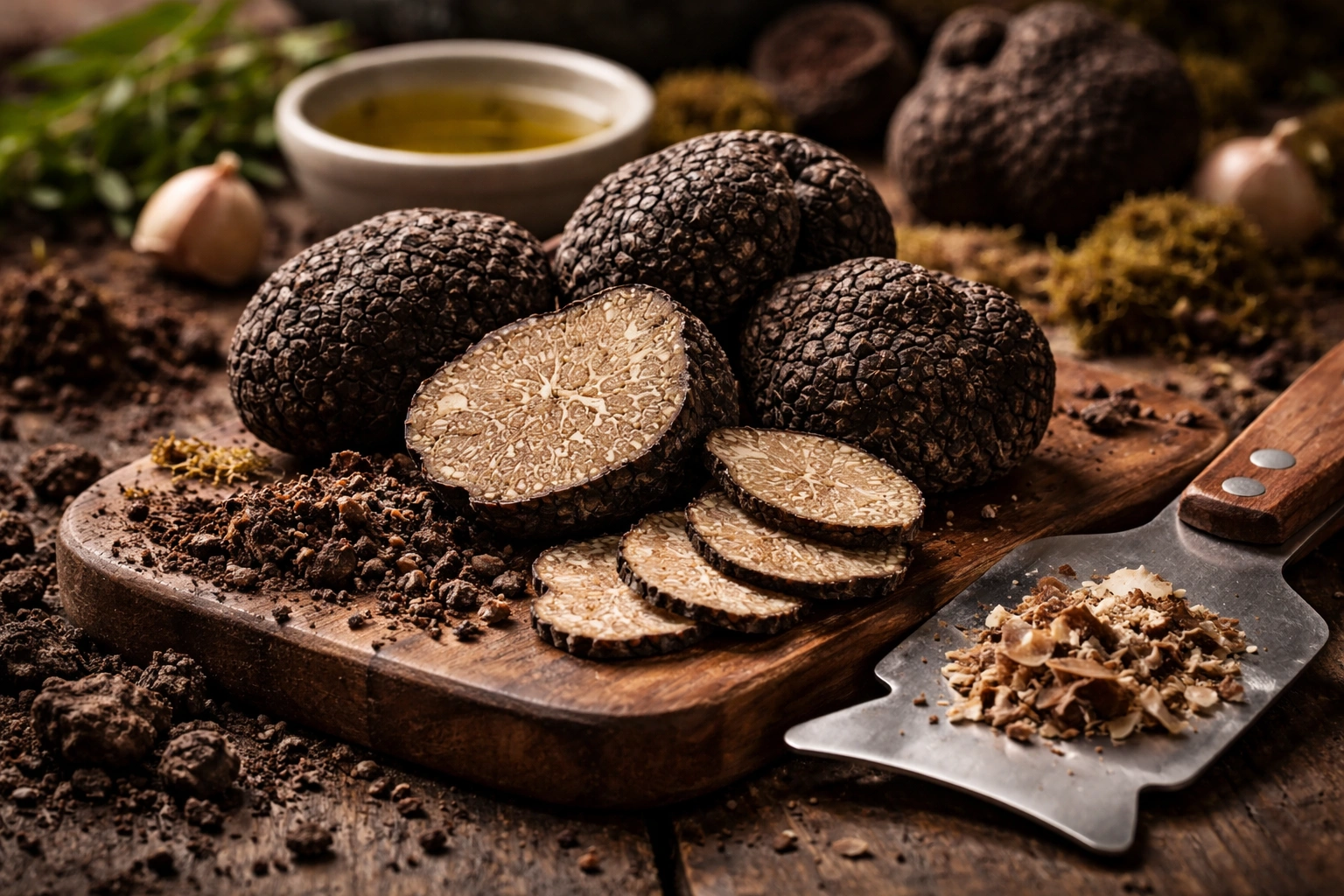
A truffle is the fruiting body of a mycorrhizal fungus belonging to the genus Tuber, within the class Ascomycetes. That classification matters more than most food writing acknowledges. Unlike the cap-and-stem mushrooms people recognize, a truffle never breaks the soil surface. What you hold in your hand is essentially a spore sac — a dense, warty, asymmetrical structure whose entire biological purpose is reproduction, not nourishment of the organism itself.
The organism doing the actual living is invisible. It exists as a branching network of microscopic filaments called mycelium, which spread through the soil and physically colonize the fine root tips of compatible host trees. This colonization is called mycorrhization. The fungus forms a sheath around those root tips, and through this structure, it dramatically expands the tree’s ability to absorb phosphorus, nitrogen, and water from surrounding soil. The tree reciprocates by supplying the fungal network with sugars produced through photosynthesis. Both organisms benefit. Neither survives as well without the other.
The truffle itself — the part humans eat — is simply the fruiting structure that forms once the fungal colony is mature enough and environmental conditions align. Many truffle fungi never produce a harvestable fruiting body in a given year, even in established orchards. That biological unpredictability is one structural reason the supply never stabilizes.
Botanically, truffles are often loosely grouped with mushrooms in culinary writing, but the distinction is real. Mushrooms are Basidiomycetes; truffles are Ascomycetes. They’re as taxonomically distinct as a pine tree is from a palm. What they share is a fungal kingdom membership and an earthy flavor profile — everything else differs considerably.
How Truffles Grow: The Biology Behind the Rarity
Growth begins with a spore. When an animal consumes a mature truffle and later deposits the spores through digestion, those spores may — under the right conditions — germinate in soil near a compatible host tree. “Right conditions” is doing enormous work in that sentence.
The soil must be calcareous, meaning rich in calcium carbonate, typically limestone-derived. pH must sit within a narrow alkaline band. Moisture levels need to be consistent but not waterlogged. The host tree must be present — oak, hazelnut, beech, poplar, or pine depending on the species — and ideally young enough to still be actively forming new fine root tips available for colonization. Competing fungi in the soil can block establishment entirely.
If germination succeeds, the hyphae develop into mycelium, which then colonizes root tips over years, not weeks. Producing an actual fruiting body — a harvestable truffle — typically takes between five and fifteen years from initial colonization, depending on species and site conditions. Even established truffle grounds, called truffières, can go seasons without fruiting if summer drought disrupts the moisture cycle during the critical August–September formation window.
This long lead time and environmental sensitivity is not an anomaly — it’s the defining biological feature that makes mass production structurally impossible for the most prized species. Research institutions have spent decades attempting to reliably induce fruiting under controlled conditions for Tuber magnatum, the white Alba truffle, and have not succeeded. It remains the only major high-value food ingredient with no viable cultivation pathway.
The Major Truffle Varieties and What Separates Them
Over 200 truffle species exist globally. Most have no culinary relevance. The handful that do differ significantly in aroma, season, price, and appropriate use — conflating them leads to disappointment, and in some cases, to being sold an inferior product at a premium price.
White Truffle (Tuber magnatum Pico) — harvested from September through January, peaking in October and November around Alba and Asti in Piedmont, and in parts of Istria, Croatia. This is the species that commands $3,000–$5,000 per pound at retail and has sold at auction for $484,000 per pound. The exterior is pale ochre to light brown, smooth relative to black varieties. The interior is marbled cream and tan. It cannot be cultivated, cannot be cooked without losing its defining aromatic compounds, and degrades within days of harvest. Gram for gram, it may be the most economically volatile ingredient in food.
Black Périgord Truffle (Tuber melanosporum Vitt) — available December through March, centered on the Périgord region of France and increasingly from Provence, Spain, and Australia’s winter harvest (July–August in the Southern Hemisphere). Unlike the white, melanosporum responds favorably to gentle heat, which actually deepens its umami character. Retail prices range from $800–$1,500 per pound. Cultivation is possible and increasingly practiced.
Burgundy Truffle (Tuber uncinatum Chatin) — ripe from September through January, with a reddish-black exterior and aromatic profile that sits between summer and winter black truffles. It’s frequently overlooked in favor of the seasonal headliners, but experienced cooks treat it as a practical workhorse: genuinely good flavor, more stable pricing, longer availability window. Often sourced from Eastern Europe.
Summer Truffle (Tuber aestivum Vitt) — May through August, same species as Burgundy but harvested earlier, before full ripeness deepens the aroma. The most widely available and affordable entry point into fresh truffle cooking. Mild and mushroomy, useful for infusing oils and butter where subtlety is the goal.
Bianchetto (Tuber borchii Vitt) — harvested January through April, sometimes sold as an alternative to white truffles at lower price points. The aroma is sharper and more garlicky than magnatum, with a petrochemical edge when not fully ripe. It has genuine value at its own price but is occasionally misrepresented.
Chinese Black Truffle (Tuber indicum) — visually nearly identical to melanosporum once cleaned, but negligible in aroma and essentially flavorless. Cheap to produce, widely imported, and regularly used to adulterate or substitute for European black truffles. If a “fresh black truffle” is priced significantly below market, indicum is the likely explanation.
What Truffles Actually Taste and Smell Like
Most flavor descriptions of truffles focus on the wrong sense. The aroma is the product. The taste is secondary — and without the volatile compounds providing olfactory input, most people find fresh truffle surprisingly understated on the palate alone.
What the nose detects is a complex mixture of sulfur-containing molecules, the most significant being dimethyl sulfide and bis(methylthio)methane, alongside a range of alcohols, ketones, and aldehydes. The specific ratio varies by species, ripeness, and soil composition. Mycologists call this the truffle’s volatolome — the complete profile of airborne compounds it emits.
In practice: white truffle smells intensely of garlic, raw fermented grain, and honey, with a pungent undercurrent that some find overwhelming and others find addictive. Black Périgord is earthier — cocoa, wet leaves, hazelnut — with less of the sulfurous punch. Burgundy is aromatic but approachable, closer to what people expect from “fancy mushroom.” Summer truffle is where the aroma is mildest, almost pleasant in a generic forest-floor way.
The important point is that terroir materially affects the aromatic profile, in the same way a wine grape from clay soil expresses differently than one from chalk. Two truffles of the same species from different forests will smell and taste differently. This variability is part of what makes experienced truffle buyers trust their nose over a certificate of origin.
Heat significantly affects aromatic compound stability. White truffles lose their defining sulfur volatiles almost immediately when exposed to temperatures above 55°C. This is why every serious chef serves them shaved raw, always at the last moment, over warm rather than hot food. Black truffles behave differently — the melanosporum aroma compounds are more thermally stable, which is why they can be folded into warm butter or stirred into risotto at the finish.
Truffle Hunting: How They Are Found
The romantic image of an old man and a snuffling dog in an Italian forest is accurate in structure if not always in atmosphere. Truffle hunting — trifolau in Piedmontese dialect — is a skilled trade with significant territorial politics, early morning starts, and a trained working animal as the indispensable partner.
Pigs were used for centuries, exploiting their natural instinct to root for the truffle’s reproductive pheromones, which structurally resemble androstenol, a compound found in boar saliva. The problem was always obvious: pigs want to eat the truffle the moment they find it. Handlers routinely lost fingers pulling pigs away from freshly located specimens. Dogs displaced pigs as the preferred hunting partner through the 20th century — they’re trainable to indicate without consuming, easier to transport, and work longer in field conditions.
Dogs are conditioned from puppyhood, typically using truffle-scented play objects, progressing over 12–18 months to reliable field performance. The best hunting dogs locate truffles buried 20–30cm underground, detect ripeness through scent, and can be worked in multiple truffle grounds within a single morning session. Working dogs in established Italian hunting families are not sold — they’re passed within the family or retained as a competitive asset.
Extraction requires care. A truffle dug carelessly damages the mycelium mat below, which can delay or eliminate future fruiting from that spot. Skilled hunters use a short-handled pick called a vanghino, excavate slowly, and backfill the hole once the truffle is removed. The relationship between hunter and ground is long-term, and experienced trifolai often work the same woods for decades.
Hunting season maps closely to the fruiting calendar: white truffles from mid-September through December in Piedmont, black Périgord from November through March in France and Spain, summer truffles from May through August across a broader geographic range.
Why Truffles Are So Expensive: The Real Economics
The price of truffles is not a luxury markup applied to a commodity. It reflects a genuine supply constraint that cannot be resolved through investment or technology — at least not for the varieties that drive the market.
Current pricing gives context. Fresh white truffles (Tuber magnatum) retail between $3,000 and $5,000 per pound in peak season; the auction record stands at $484,000 per pound for an exceptional single specimen. Black Périgord (melanosporum) ranges from $800 to $1,500 per pound retail, with Italian market prices in 2025–2026 averaging €350–€600 per kilogram at source. These are not stable figures. A single poor rainfall season in Piedmont — the region recorded 18% below-average precipitation in 2024 — drove white truffle spot prices up by over $1,100 per pound within a two-week period.
Several factors compound the base supply constraint. The shelf life of fresh truffle is seven to ten days from harvest under optimal storage conditions (34°F/1°C, breathable wrapping, refrigerated). This brevity collapses the logistical window for export: truffles harvested in Alba on a Saturday must be in a restaurant walk-in in New York or Tokyo by Tuesday or Wednesday to still be at peak aroma. Overnight freight is mandatory, and during December — peak season — cargo space tightens, pushing freight surcharges to $6 per kilogram or more.
Restaurant economics compound the retail price further. An 8-gram shaving of black truffle over risotto that costs a Manhattan restaurant $18 in ingredient value appears on a menu at $65 — standard fine-dining food cost logic. A 3-gram supplement of white truffle on wagyu strip at $95 translates to an effective ingredient pricing of roughly $1,430 per pound. The consumer is paying for the scarcity, the logistics chain, and the kitchen labor — and also for the opportunity, because truffle in peak condition is not available on demand.
The production decline is structural. Global truffle production has fallen dramatically over the past century. France once produced over 1,000 metric tons annually in the late 1800s; current estimates sit between 30 and 50 metric tons for melanosporum in good years. Deforestation, soil degradation, agricultural land conversion, and the chronic under-investment in truffle woodland management have shrunk the productive area. Climate change is extending summer drought periods in historically reliable zones, further pressuring yields. There is no policy lever that reverses this quickly.
Truffle vs. Truffle Oil: The Deception Most People Miss
This is the issue most truffle content sidesteps, perhaps out of commercial caution. It deserves plain language.
The vast majority of truffle oil sold globally contains no truffle. The dominant flavoring agent is 2,4-dithiapentane, a synthetic petrochemical compound that replicates one of the sulfur molecules found in real truffle aroma. It’s inexpensive to manufacture, stable at room temperature, and extremely potent. A few drops in a liter of olive oil produces something that smells aggressively of “truffle” to anyone who has not spent time with the real ingredient.
The legal framework enables this deception. A product can be labeled “truffle flavored” or even carry images of truffles while containing no actual truffle — provided the flavoring source is disclosed somewhere in the ingredient list. “Natural truffle aroma” in an ingredient declaration often refers to this same synthetic compound, produced through a biosynthetic route that technically allows the “natural” classification under current EU and FDA frameworks.
Real truffle-infused oils do exist. They require actual truffle pieces steeped in high-quality olive oil, have a limited shelf life, and cost proportionally more. The label will show Tuber melanosporum or Tuber magnatum in the ingredient list with a percentage. If you see only “truffle flavoring,” “natural aroma,” or no species name, the oil contains no meaningful truffle content.
Truffle butter and truffle salt are more reliable product categories. Butter requires actual truffle pieces to be present to function as advertised, and most producers comply because the cost difference is manageable. Salt products similarly tend to use real dehydrated truffle in meaningful quantities. These are legitimate ways to access truffle flavor at an accessible price point.
How to Use, Store, and Buy Fresh Truffles
Buying: The quality indicators for fresh truffle purchasing are tactile and olfactory, not visual. A good truffle should feel firm with a slight spring-back when pressed gently between thumb and forefinger — mushiness indicates over-ripeness and imminent flavor loss. The exterior should be aromatic through the wrapping; if you have to hold it close to your nose, it’s not at peak. For white truffles, globosity (how close to a sphere the specimen is) and surface regularity both correlate with quality and price. Irregular, heavily lobed specimens grow in compacted or stony soil, producing a higher ratio of peridium (skin) to gleba (interior flesh). Avoid any truffle with visible mold, significant soft spots, or insect damage.
Storage: Wrap each truffle individually in dry kitchen paper. Place in a sealed glass jar. Refrigerate. Change the paper daily — moisture accumulation accelerates deterioration faster than anything else. Use within five to seven days of purchase. If storing alongside eggs, the shells will absorb truffle aroma through their porous surface within 24–48 hours, producing what serious cooks consider one of the most effortlessly luxurious breakfast preparations available.
Using: The single most important rule — restraint in application, simplicity in the supporting dish. Truffle does not enhance complex flavors; it dominates them. Dishes built around eggs, pasta, risotto, or butter-finished proteins allow the truffle to express itself without competition. For white truffle, use a mandoline or dedicated truffle slicer to produce the thinnest possible shavings, applied directly to warm (not hot) food at the moment of service. Warmer dishes will volatilize the aroma faster — not necessarily a problem, but something to account for in timing. For black truffles, gentle heat is an option: fold into warm beurre blanc, stir into finished risotto, or combine with cream just off the boil to make a sauce.
Dosage by species: white truffle at 5–10 grams per person is sufficient — the intensity means restraint pays dividends. Black Périgord at 10–15 grams per person, given the milder aromatic output and the need for the flavor to register through cooked elements.
The Global Truffle Map: Where Cultivation Is Expanding
The geography of truffle production has changed more in the past thirty years than in the preceding three centuries.
Italy and France remain the traditional anchors. Piedmont’s Langhe hills produce the most prized white truffles; the Périgord and Provence regions of France dominate black Périgord production alongside significant Spanish harvests from Teruel and Soria provinces. Umbria and Tuscany produce both black and white species, with Acqualagna in Le Marche hosting one of the most significant annual truffle markets.
What has changed is the Southern Hemisphere. Australia began commercial black truffle production in the 1990s, with Tasmania and Western Australia now producing melanosporum from July through September — winter in the Southern Hemisphere, which creates an off-season supply for the Northern Hemisphere market. New Zealand and Chile have followed comparable development trajectories. The quality is genuine; the aroma profile of well-managed Southern Hemisphere melanosporum is indistinguishable from French equivalents in blind tastings.
North America has developed a native species industry around Tuber oregonense and Tuber gibbosum in the Pacific Northwest — Oregon particularly. These Oregon white truffles have developed a legitimate following among American chefs who appreciate a locally sourced equivalent, though the aroma profile differs from magnatum and the supply chain is less organized. Cultivation research at institutions like Oregon State University is advancing the understanding of North American truffle ecology considerably.
Britain presents one of the more interesting revival stories. England has a documented truffle history — Victorian-era records show regular harvests in the New Forest and parts of Sussex — that was almost entirely abandoned through the 20th century. The summer truffle (Tuber aestivum) grows naturally in chalk woodland across the Chilterns, North and South Downs, and into Hampshire. A focused revival of both foraging and orchard cultivation is now underway in Wiltshire, Yorkshire, and parts of Scotland. Small commercial harvests are reaching restaurants, and orchard plantings from the past decade are beginning to fruit.
Nutritional Profile and Historical Context
The historical record on truffles reaches further than most culinary histories acknowledge. The earliest documented references appear in neo-Sumerian inscriptions from approximately the 20th century BC, describing the truffle as a food consumed by enemies of the Amorites — suggesting it was considered an unusual or wild food. Ancient Greeks referenced it; Theophrastus and later Dioscorides wrote about what appear to be truffle species. Romans elevated the truffle to luxury status. Apicius included truffle preparations in De re coquinaria. Roman mythology attributed their origin to lightning striking damp earth near oak trees — an explanation that held cultural weight for centuries before mycology provided a better one.
The first known attempt at truffle cultivation was made by Joseph Talon, born in 1793 in Saint-Saturnin-lès-Apt in Provence. He observed that oak seedlings near productive truffle grounds, when transplanted, sometimes produced truffles at the new site. He began systematically planting acorns and hazelnut seedlings in suitable terrain — a founding act of what would eventually become modern trufficulture. French mycologists René Delmas and later Chevalier and Frochot developed tree inoculation techniques in the mid-to-late 20th century that made reliable orchard establishment possible for cultivable species.
Nutritionally, truffles contain surprisingly substantial protein (approximately 20–30% of dry weight depending on species), meaningful fiber content, B vitamins including B2 and B3, and trace minerals including zinc, manganese, and iron. They are low in fat and calories. This profile is rarely the reason anyone buys them, but it challenges the assumption that truffles are purely hedonistic — the ingredient has genuine micronutrient density relative to its mass.
The bioactive compound research is more recent and less conclusive. Studies have identified polysaccharides with potential antioxidant activity in several Tuber species, and some research suggests antimicrobial properties in specific volatile fractions. This is an active research area, not established nutrition science — worth noting, not overstating.




 News2 years ago
 Lifestyle3 years ago
 Lifestyle4 years ago
 Wealth2 years ago