What people wear at work can influence comfort, confidence, and even how customers see a business. A well-planned uniform does not need to be complicated or expensive. In many cases, a few practical clothing choices can create a consistent appearance while still allowing employees to move comfortably throughout the day.
The challenge is finding clothing that looks professional, suits the working environment, and remains easy to wear and maintain. Polo shirts and jackets are two popular choices because they can work across different industries, seasons, and job roles.
Here are some practical points to consider when choosing clothing for a professional team.
Start With the Working Environment
Before choosing colors or designs, think about where the clothing will actually be worn.
Someone working in an air-conditioned office has different needs from an employee who spends several hours outdoors. Warehouse staff may need freedom of movement, while customer-facing employees may need a slightly more polished appearance.
Climate matters as well. Lightweight fabrics can make working in warm conditions more comfortable, while an additional outer layer may be useful during cooler mornings, rainy weather, or heavily air-conditioned environments.
Understanding these everyday conditions makes it much easier to choose garments employees will actually enjoy wearing.
Choose Clothing That Is Easy to Wear
A good uniform should make the working day easier, not more uncomfortable.
This is one reason เสื้อโปโล remain such a practical option for many businesses. They sit comfortably between casual and formal clothing. A polo can look neat enough for customer-facing work without feeling as restrictive as a traditional dress shirt.
They can work particularly well for retail teams, technicians, sales staff, event crews, office employees, delivery teams, and hospitality businesses.
The most important factor is fit. Employees should have enough room to move naturally without the shirt looking oversized. Sleeves, collars, and seams should also remain comfortable after several hours of wear.
Think About Fabric Before Appearance
Color and design usually get the most attention, but fabric can have a much bigger effect on everyday comfort.
For active jobs, breathable material can help employees remain comfortable during long shifts. In environments where clothing may become dirty quickly, durability and ease of washing become more important.
You should also consider how the material behaves after repeated washing. A uniform may look excellent when new, but it offers little long-term value if it quickly loses its shape or becomes uncomfortable.
The ideal fabric depends on the job, so there is no single material that works for every business. The goal is to balance appearance, comfort, durability, and maintenance.
Add an Outer Layer When Needed
Not every employee needs to wear a jacket throughout the day, but having one available can make a uniform far more flexible.
Businesses that need clothing without waiting for a completely new design or production process may consider เสื้อแจ็คเก็ตสำเร็จรูป as a practical starting point. They can provide an additional layer for cooler environments while helping employees maintain a consistent appearance.
Jackets can also be useful for staff members who regularly move between indoor and outdoor spaces. Delivery personnel, service technicians, event workers, security teams, and field staff are common examples.
When selecting jackets, pay attention to movement around the shoulders and arms. Pockets should also be positioned where they are genuinely useful rather than included only for appearance.
Keep the Design Simple
It can be tempting to add several colors, large graphics, different trims, and multiple decorative details to a company uniform. In practice, simpler designs often age better.
A limited color palette is easier to coordinate across different garments. For example, a company can use the same main colors on shirts, jackets, hats, or other workwear without requiring every item to look identical.
Simple clothing also gives company branding more room to stand out. A small embroidered or printed logo can often look cleaner and more professional than a design surrounded by unnecessary visual elements.
The aim should be recognition rather than decoration.
Consider Different Roles Within the Same Team
A uniform does not necessarily mean every employee has to wear exactly the same item.
Different roles often have different practical requirements. Front-desk staff may spend most of the day indoors, while another employee from the same company may regularly visit customers or work outside.
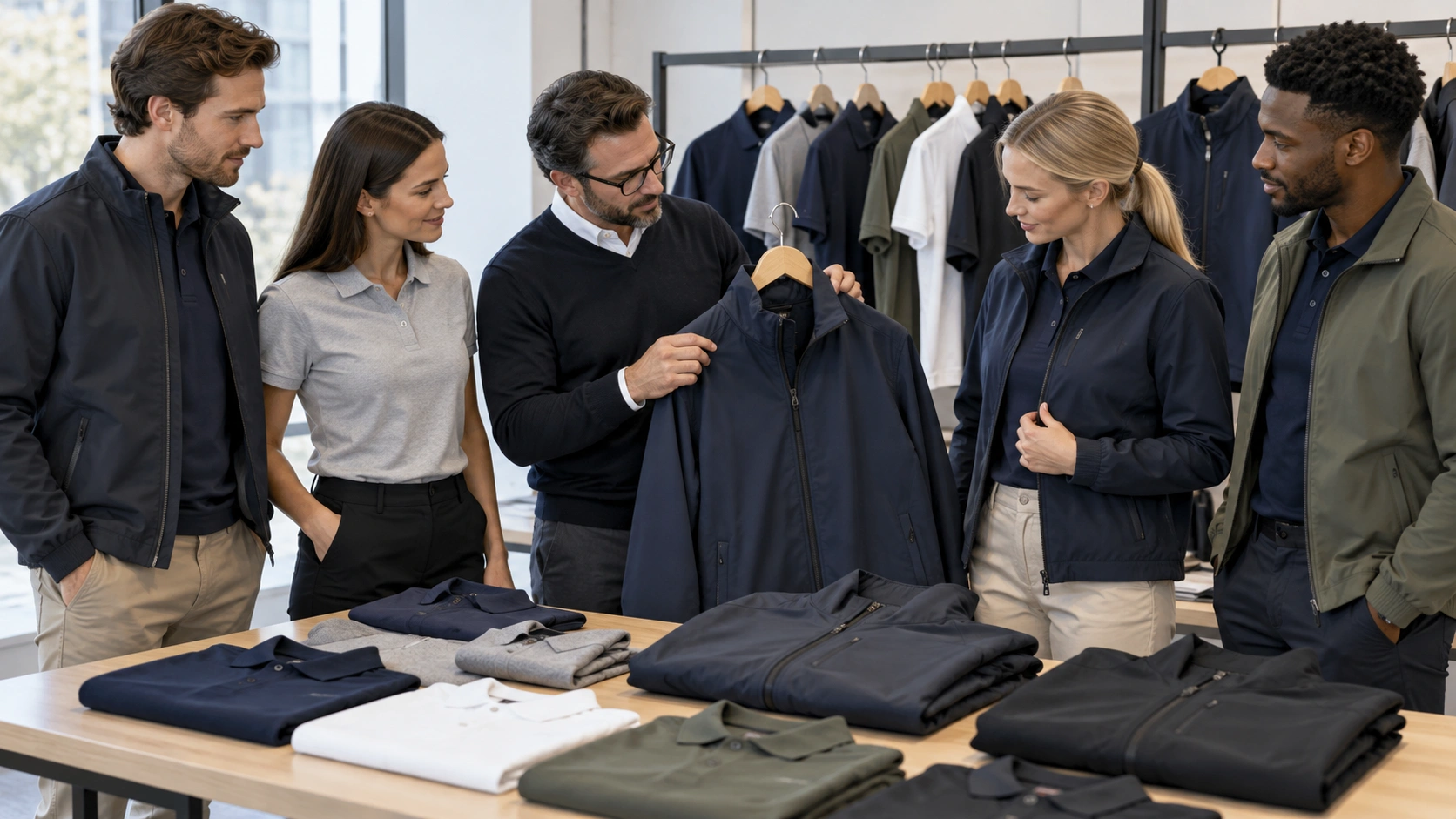
Instead of forcing one garment to serve every purpose, businesses can create a small coordinated wardrobe. Polo shirts may serve as the everyday base, while jackets provide an optional outer layer when conditions require one.
Using matching or complementary colors keeps the team visually connected even when individual employees are wearing different pieces.
Make Sizing a Priority
Even a high-quality garment can look unprofessional when the fit is wrong.
Before placing a larger order, it is worth collecting accurate size information from the people who will actually wear the clothing. Avoid assuming that employees who normally buy the same general size will automatically fit the same uniform size.
Different garment styles and manufacturers can have slightly different measurements.
Where possible, check the actual sizing chart or arrange samples before confirming a larger quantity. It can prevent unnecessary exchanges and help employees feel more comfortable from the beginning.
Think About Long-Term Replacement
Uniform planning should include what happens several months after the first order.
New employees may join. Existing clothing may eventually need replacing. Some garments may become damaged through normal work.
Choosing designs and colors that can be reordered makes these situations easier to manage. Extremely unusual colors or complicated custom features may be harder to reproduce consistently later.
Keeping basic records of garment models, colors, sizes, and previous quantities can also make repeat orders much simpler.
Comfort Can Affect How Often the Uniform Is Worn
Businesses sometimes focus heavily on how a uniform looks to customers while overlooking the experience of the person wearing it.
That can be a mistake.
If clothing feels too hot, restricts movement, irritates the skin, or does not fit properly, employees are naturally less likely to feel comfortable wearing it. Over time, this can lead to inconsistent uniform use.
Comfort and professional appearance do not have to compete with each other. A carefully chosen polo shirt or lightweight jacket can provide both.
Asking employees for practical feedback can also reveal small issues that are difficult to notice from a product description alone.
Build a Small, Flexible Workwear System
For many organizations, the most effective uniform is not a complicated collection of clothing. It is a small group of dependable garments that can be combined according to the weather and the employee’s role.
A comfortable polo shirt can serve as the everyday foundation. Jackets can provide extra protection or warmth when necessary. Consistent colors and restrained branding can then connect the different pieces into one recognizable company look.
This approach also makes future purchasing easier because businesses can replace individual garments without redesigning the entire uniform.
Ultimately, good workwear should feel practical enough for everyday use while still presenting the business professionally. By considering the working environment, fabric, fit, sizing, maintenance, and long-term replacement from the beginning, companies can choose clothing that works well for both employees and the organization.




 News2 years ago
 Lifestyle4 years ago
 Lifestyle4 years ago
 Wealth2 years ago